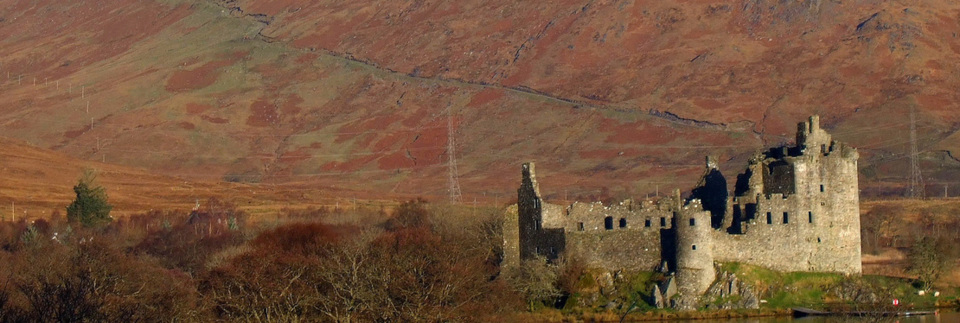
 The Castles of Scotland
Scalloway Castle
Scalloway Castle, a substantial and imposing old ruinous castle, at Scalloway on the mainland of Shetland, was built by the notorious Patrick Stewart, Earl of Orkney.
 Scalloway Castle (© Georgi Coventry)
Shetland: About 5 miles west and south of Lerwick, on the west coast of Shetland mainland, on minor roads south of A970, at Scalloway Castle.
HES HU 404392 OS: 4 ZE1 0TQ
OPEN: Key available from Scalloway Museum during normal opening hours (www.scallowaymuseum.org).
Tel: 01856 841815 Web: www.historicenvironment.scot
Thanks to (and ©) Georgi Coventry for the colour photos.
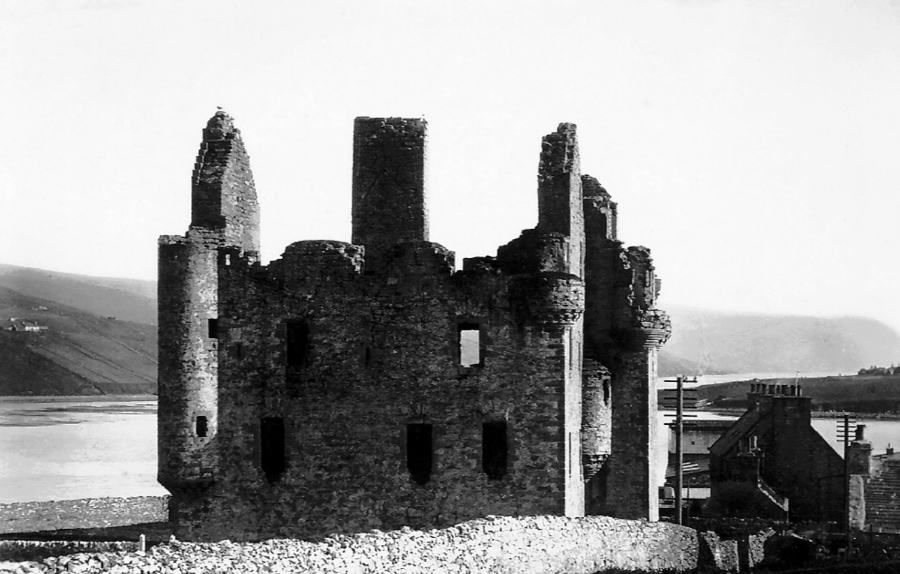 Scalloway Castle (old postcard)
Located on a peninsula in East Voe, Scalloway Castle is a 17th-century L-plan tower house of four storeys and a garret. It consists of a main block and a smaller square offset wing, with a large stair-turret, corbelled out above first-floor level, at one corner. Bartizans crowned the corners of the tower, and the walls are pierced by shot-holes. The castle was dated 1600.
 Scalloway Castle (© Georgi Coventry)
The arched entrance is in the main re-entrant angle, at the foot of the square wing. It leads to a scale-and-platt stair, which climbed only to the first floor, and into the vaulted basement. A passage led to a cellar, and to the kitchen, with a fireplace and well. The hall occupied the first floor of the main block. A stair in the corbelled-out turret, and another in the re-entrant angle, led to the upper floors, which were occupied by private chambers.
 Scalloway Castle (© Georgi Coventry)
‘Scola Vo’ is marked on Blaeu’s map of Shetland (1654), and ‘Scalloway Castle’ is depicted on Thomson’s map of Shetland (1827), though probably not accurately. The OSNB (Shetland 1877-1878) notes, ‘The ruins of a castle … its shape is an elongated square with a wing jutting south and west, and is finished at each angle with a neat round tower projecting about four feet and about 20 feet from the base of the wall. The walls are of considerable thickness, being in some cases about six feet. The walls stand about three-storeys high, the lower flat being arched over.’
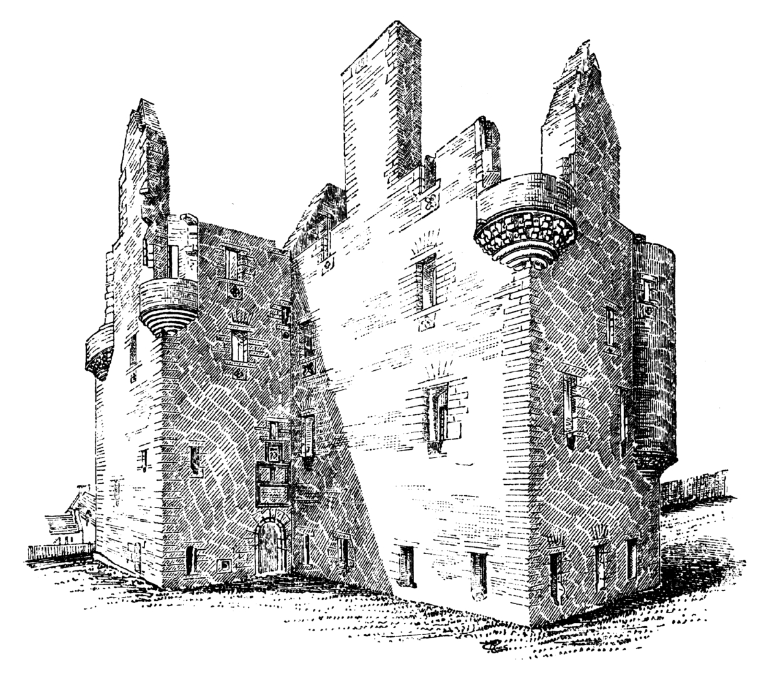 Scalloway Castle (MacGibbon and Ross)
The castle was built by Patrick Stewart, Earl of Orkney and Lord of Shetland, in 1600. He was known as 'Black Patie' and was unpopular with both the Orcadians and the folk of Shetland, forcing local people to work on the castle and taxing them to pay for materials. Earl Patrick and his son Robert were both executed for treason in 1615. The property went to the Sinclairs, and John Sinclair of Scalloway had a ratification in his favour in 1641. A form of the guillotine was in use to execute wrongdoers in Scalloway in the 1640s.
 Scalloway Castle (© Georgi Coventry)
The castle was occupied by Cromwell’s forces in the 1650s, and was abandoned by the end of the 17th century. In 1878 the castle was owned by Thomas Dundas, Earl of Zetland. In 1908 the castle was given over to the State, the vaults were repaired or rebuilt, and is in the care of HES.
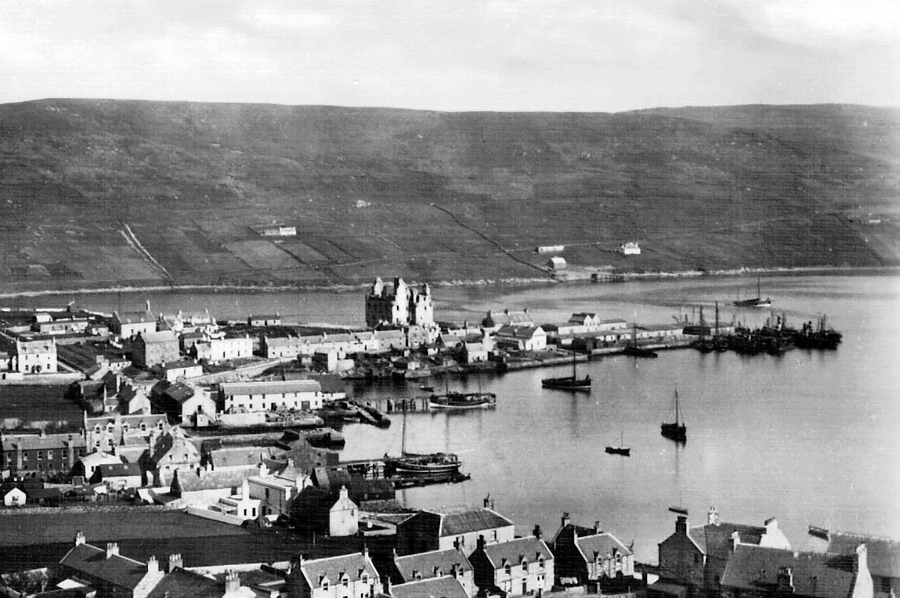 Scalloway Castle (old postcard)
Materials from Scalloway were used in the building of Haa of Sand [HU 344471] in the middle of the 18th century, including two doorways.
Old Haa of Scalloway [HU 404394], a three-storey building, dates from the middle of the 18th century, and there is a panel with James Scott and
Katharine Sinclair, who owned the property at that time. The house has been divided into flats.
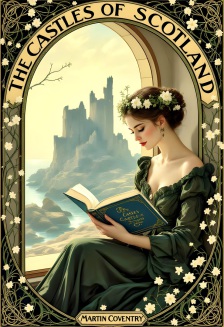
 The Castles of Scotland New Sixth Edition by Martin Coventry
New sixth edition.
The book is now available.
 Viridian: a vivid blend of book and website
Check any and all opening and access information with the sites themselves…





Contact Us


Goblinshead
Cockenzie House
22 Edinburgh Road
Cockenzie
EH32 0HY
Email: info@thecastlesofscotland.co.uk
Or use our contact form.



 Print
Print 